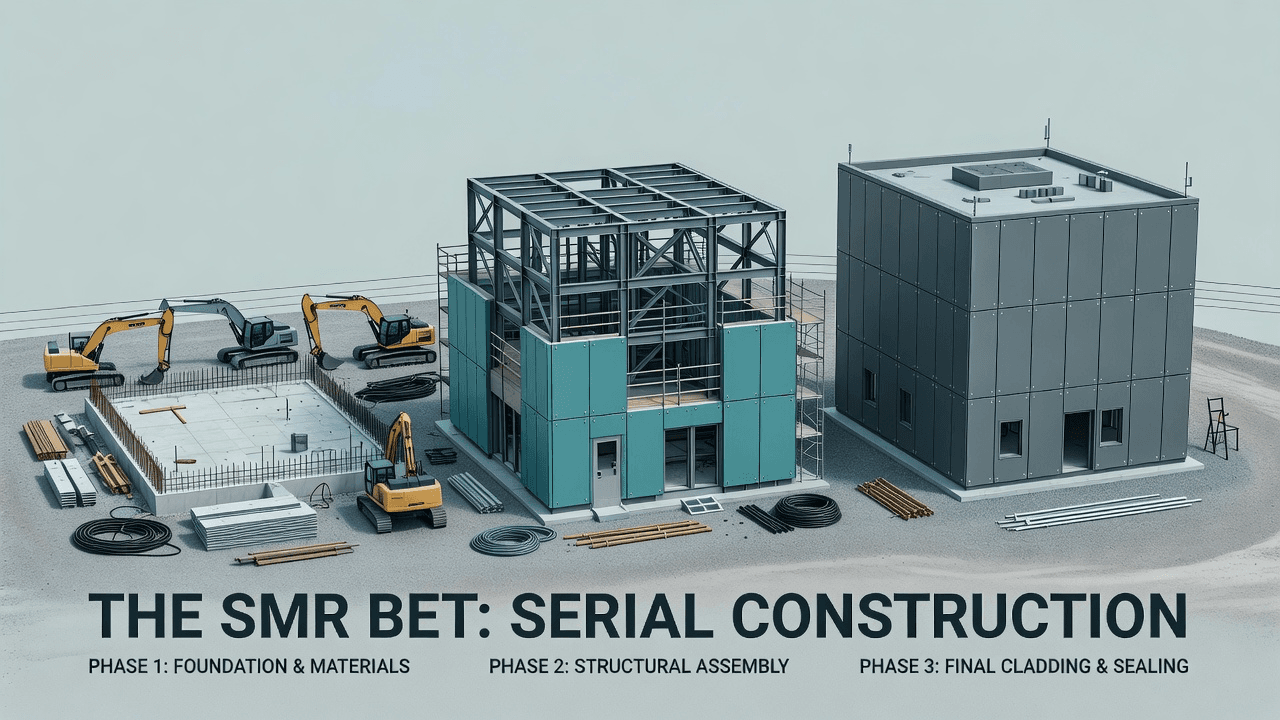
Small modular reactors (SMRs) are nuclear power plants that produce up to roughly 300 MWe per module — about a third of a conventional reactor — designed so that major components can be built in factories and assembled on site rather than constructed as bespoke megaprojects. The promise is serial production: build the same unit many times, get faster and cheaper each time. In 2026 that promise finally has construction sites to point at.
Key facts
- The IAEA defines SMRs as reactors of up to 300 MWe per module, factory-fabricated and transportable to site
- The OECD Nuclear Energy Agency counts 127 SMR designs worldwide, 74 in active development
- Only one design holds full US NRC design certification: NuScale's module, certified January 2023, with its uprated 77 MWe US460 receiving Standard Design Approval in May 2025
- The first Western SMR is under construction: GE Vernova Hitachi's BWRX-300 at OPG's Darlington site in Ontario, four units totalling 1,200 MW
- TerraPower's Natrium plant broke ground in Kemmerer, Wyoming in April 2026 — the first US utility-scale advanced reactor to enter construction
Why "small" and "modular" matter
Conventional nuclear plants are among the largest construction projects on Earth, and their economics suffer for it: every site is a first-of-a-kind, schedules stretch, and financing costs compound. SMRs invert the model. A smaller reactor can be standardized, its heaviest components manufactured on a production line, and its safety case simplified — many designs rely on passive cooling that needs no operator action or external power. Smaller units also fit markets a gigawatt plant cannot: replacing a retiring coal unit, powering an industrial site, or matching the load of a data-center campus.
The trade-off is that a small reactor produces less revenue per licence, per operator, and per acre. The entire SMR bet is that repetition — the learning curve of building the same unit again and again — outruns the lost economies of scale. That bet is unproven, which is why the serial programs now taking shape matter more than any single reactor.
The landscape
The field is crowded: the NEA's latest dashboard counts 127 designs, with 74 under active development. They fall into two broad families.
Light-water SMRs shrink proven pressurized- or boiling-water technology. The BWRX-300 (GE Vernova Hitachi, 300 MWe) leads on deployment; Westinghouse's AP300 packages AP1000 passive safety at 300 MWe; NuScale's 77 MWe module holds the only full US design certification. Holtec's SMR-300 is in NRC environmental review for the Palisades site in Michigan.
Advanced (non-light-water) designs change the coolant to unlock new capabilities. TerraPower's Natrium pairs a sodium-cooled fast reactor with molten-salt thermal storage; X-energy's Xe-100 is a high-temperature gas-cooled reactor aimed at industrial heat, with a construction permit for Dow's Texas site under NRC review. These trade licensing familiarity for higher temperatures, storage, or fuel advantages.
For a decision-oriented look at the three leading contenders, see BWRX-300 vs AP300 vs Natrium.
Deep dives
- The BWRX-300, explained — the design furthest along in the West
- Natrium, explained — the reactor with a built-in battery
- BWRX-300 vs AP300 vs Natrium — side-by-side comparison
Latest developments
- Poland's Orlen Synthos seeks CfD backing for 14 BWRX-300 SMRs — July 2026
- OPG seeks licence to operate first G7 small modular reactor — June 2026
- NRC opens environmental review of Holtec's Palisades new-build — June 2026
Current state (July 2026)
Construction is real in two places: Darlington, Ontario (BWRX-300 unit 1, targeting completion by the end of the decade) and Kemmerer, Wyoming (Natrium, construction expected to run about five years). Poland's proposed 14-unit BWRX-300 program would be the first true serial order in Europe if its financing framework lands. The next eighteen months of milestones — operating licences, safety evaluations, first-concrete dates — will separate the handful of deployable designs from the other hundred and twenty.
Questions
- What is a small modular reactor?
- A nuclear reactor producing up to about 300 MWe per module — roughly a third of a conventional plant — designed so major components can be factory-built and assembled on site, per the IAEA definition.
- Which SMR is furthest along in the West?
- GE Vernova Hitachi's BWRX-300 at OPG's Darlington site in Ontario: construction is underway and OPG has already applied for its operating licence, which would make it the first operating SMR in a G7 country.
- When will the first Western SMRs generate power?
- Darlington's first BWRX-300 targets completion by the end of the decade; TerraPower's Natrium plant in Wyoming expects construction complete around 2031.
- Are SMRs cheaper than large reactors?
- Unproven. The bet is that factory repetition drives costs down a learning curve; per-MW costs of first units are higher than large plants. The first serial programs — Darlington's four units, Poland's proposed fourteen — are the test.
Sources
- What are Small Modular Reactors (SMRs)? — IAEA
- There are now 127 different SMR designs, finds NEA report — World Nuclear News
- NRC Certifies First U.S. Small Modular Reactor Design — US Department of Energy
- BWRX-300 Reactor in Darlington, Ontario — GE Vernova
- TerraPower Commences Construction on America's First Utility-Scale Advanced Nuclear Power Plant — TerraPower
About Nuclear News Network
Nuclear News Network (NNN) is an independent publication covering the global nuclear energy sector — reactor construction, SMRs, fuel supply, policy, operations and fusion. NNN publishes a daily brief, same-day analysis of major developments, and reference guides used across the industry. Articles are produced by the NNN Newsroom, an editorial automation system with human oversight, under the publication's editorial standards.